How to Create a Cash Flow Forecast in Google Sheets for a Small Business
Learn how to build a powerful cash flow forecast in Google Sheets for your small business — step by step, with formulas, templates, and pro tips to keep your finances on track.
SMALL BUSINESSES
Running a small business requires more than making sales and serving customers. One of the biggest challenges entrepreneurs face is managing cash. Many businesses fail not because they are unprofitable, but because they run out of cash at the wrong moment. Bills arrive, salaries must be paid, suppliers need payment, and if the money is not available at that moment, the business can face serious problems.
This is where a cash flow forecast becomes extremely valuable. A cash flow forecast allows business owners to predict how much money will come into the business and how much money will leave the business over a certain period of time. Instead of guessing whether the company will have enough cash next month, the forecast provides a clear financial picture.
The good news is that creating a cash flow forecast does not require expensive accounting software. A simple tool like Google Sheets can help you build an effective financial forecast that helps you stay organized and make smarter decisions.
This guide will walk you through how small business owners can create a practical cash flow forecast using Google Sheets.
What Is a Cash Flow Forecast?
A cash flow forecast is a financial planning document that estimates how much money will move in and out of a business over a period of time. The purpose of the forecast is to help business owners understand whether they will have enough cash available to operate their business smoothly.
Unlike traditional financial statements that show profits and losses, a cash flow forecast focuses strictly on real money entering and leaving the business bank account. This distinction is very important.
For example, a business might record a sale today, but if the client does not pay for thirty days, the cash is not actually available yet. At the same time, the business might have to pay rent, payroll, or inventory before receiving that payment. A cash flow forecast helps business owners understand this timing difference.
Why Cash Flow Forecasting Is Important for Small Businesses
Cash flow forecasting is one of the most important financial habits a small business owner can develop. When a business understands its expected cash position in advance, it becomes easier to avoid financial stress and make better decisions.
Prevent unexpected cash shortages
A forecast allows business owners to see future cash problems before they happen. If the forecast shows that the business may run low on cash in a certain month, there is time to take action. The owner might delay non-essential spending, increase marketing efforts, or speed up customer payments.
Plan business growth more safely
Growing a business usually requires money. Hiring employees, purchasing inventory, launching advertising campaigns, or expanding services all require cash. A forecast helps determine whether the business can afford these investments.
Make smarter financial decisions
When business owners understand how money flows through their company, they are in a much better position to make financial decisions. Instead of relying on guesswork, they can rely on actual projections.
Reduce financial stress
Many entrepreneurs feel anxious about their finances simply because they do not have visibility into their numbers. A cash flow forecast provides clarity and confidence.
Preparing the Information You Need
Before creating your spreadsheet, gather a few important pieces of financial information. You do not need perfect data to begin. A reasonable estimate is enough to build a useful forecast.
Here are some of the numbers you should prepare:
• Your current business bank balance
• Expected customer payments
• Regular monthly expenses such as rent or software subscriptions
• Payroll or contractor payments
• Inventory purchases
• Marketing expenses
• Loan payments or taxes
• Any one-time costs expected in the coming months
The more accurate these estimates are, the more useful your forecast will be.
Creating the Forecast in Google Sheets
Once you have gathered your financial information, you can begin building the forecast.
Start by opening Google Sheets and creating a new spreadsheet. Give the document a clear name such as “Small Business Cash Flow Forecast.”
Your spreadsheet should be organized so that time periods run across the top of the page. These periods could represent months or weeks depending on how detailed you want the forecast to be. Many small businesses prefer a monthly forecast covering the next six to twelve months.
Along the left side of the spreadsheet, create categories that represent the major parts of your cash flow.
The first category should represent your opening cash balance. This is simply the amount of cash currently available in your business bank account.
The next section should focus on cash inflows. These are the sources of money entering the business. Common examples include customer payments, product sales, service revenue, or other income.
After listing your inflows, create a section for cash outflows. These represent the money leaving the business. Typical examples include rent, employee salaries, inventory purchases, marketing expenses, insurance, and other operating costs.
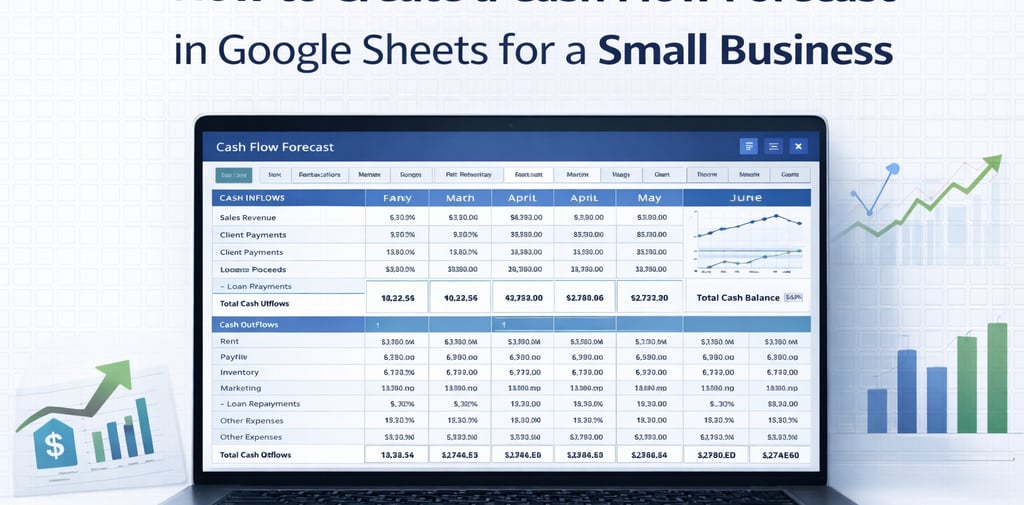
At the bottom of the spreadsheet, create rows that summarize the overall cash position. These rows will help you see whether the business expects to gain or lose cash during each period.
Estimating Cash Inflows
Cash inflows represent the money your business expects to receive.
For many small businesses, the primary inflow will be revenue from customers. When estimating these numbers, it is important to consider when customers actually pay rather than when the sale occurs.
For example, if your business typically receives payments two weeks after an invoice is sent, your forecast should reflect that delay.
Other possible inflows might include grants, loans, investment funds, refunds, or other sources of income.
Being realistic about inflows is extremely important. It is better to slightly underestimate income than to rely on overly optimistic projections.
Estimating Cash Outflows
Cash outflows represent the expenses your business expects to pay during the forecast period.
These may include:
• Office or retail rent
• Salaries and wages
• Contractor payments
• Utilities and internet
• Inventory purchases
• Marketing campaigns
• Insurance costs
• Software subscriptions
• Loan payments
• Taxes
When listing expenses, remember that some costs occur every month while others may occur only occasionally. Including both types of expenses ensures that your forecast reflects the real financial situation of your business.
Understanding Net Cash Flow
After estimating inflows and outflows, the next step is to compare them. The difference between money coming in and money going out represents the net cash flow.
If more money enters the business than leaves it during a given period, the net cash flow is positive. This means your cash position improves.
If expenses exceed income, the net cash flow becomes negative, meaning the business is spending more cash than it receives.
Tracking this number helps business owners quickly understand whether they are moving in the right financial direction.
Tracking the Closing Cash Balance
The closing cash balance shows how much money the business expects to have at the end of each period.
This balance becomes the starting point for the next month or week. By connecting each period together, the forecast shows how the business’s cash position evolves over time.
Watching this number carefully helps identify future financial pressure points. If the balance begins to decline too much, it may signal the need to adjust spending, increase sales efforts, or collect payments faster.
Improving the Forecast Over Time
Your first forecast does not need to be perfect. In fact, most forecasts improve gradually as business owners become more familiar with their financial patterns.
Over time, you may begin to notice seasonal trends in sales or expenses. Some months may be stronger than others. Updating the forecast regularly allows the spreadsheet to become more accurate and more useful.
Many successful entrepreneurs review their cash flow forecast every week or at least once per month.
Common Mistakes to Avoid
When creating a cash flow forecast, a few common mistakes can reduce its usefulness.
One mistake is confusing profit with cash. A company might show a profit on paper but still struggle with cash shortages if customers pay slowly.
Another mistake is ignoring irregular expenses such as tax payments, annual subscriptions, or equipment repairs.
Some forecasts also fail because the estimates are too optimistic. It is important to build projections that reflect realistic expectations.
Finally, some business owners create a forecast once and never update it again. A forecast only works if it is reviewed and updated regularly.
Why Google Sheets Works Well for Cash Flow Forecasting
Google Sheets is a practical tool for small businesses because it is flexible, easy to access, and free to use. Business owners can access their spreadsheet from any device, share it with partners or accountants, and customize it according to their needs.
As the business grows, the spreadsheet can also evolve. Charts, dashboards, and additional financial tracking tools can be added to make the forecast even more powerful.
Final Thoughts
A cash flow forecast is one of the most valuable financial tools a small business owner can create. It helps transform financial uncertainty into a clear plan. Instead of reacting to money problems after they occur, entrepreneurs can anticipate challenges and prepare for them in advance.
Creating a forecast in Google Sheets is a simple yet powerful way to gain visibility into your business finances. With a clear structure and regular updates, this tool can help small business owners stay in control of their cash and build a stronger, more resilient company.